


A headstone engraving machine creates names, dates, inscriptions, portraits, and decorative designs on granite, marble, and other memorial stones. Common options include CNC stone routers, impact engravers, laser engraving machines, and sandblasting systems.
In this guide, we compare the main types of headstone engraving machines, including CNC, impact, laser, and sandblasting systems. You’ll learn how each method differs in engraving depth, image detail, production speed, and cost, so you can choose the right machine for your memorial projects.

In this article:
- Part 1: 4 Types of Headstone Engraving Machines
- Type 1: CNC Stone Engraving Machines
- Type 2: Impact Engraving Machines
- Type 3: Laser Engraving Machines
- Type 4: Sandblasting Systems
- Part 2: Why Laser Engraver is the Best Headstone Engraving Machine
- FAQs: Hot Questions about Headstone Engraving Machine
Part 1: 4 Types of Headstone Engraving Machines
The main types of headstone engraving machines are CNC stone engravers, impact engravers, laser engravers, and sandblasting systems. The right choice depends on the stone, required engraving depth, design complexity, production volume, and available workspace.
Type 1: CNC Stone Engraving Machines
A CNC stone engraving machine uses computer-controlled cutting tools to carve text and designs into granite, marble, and other natural stones. Because the tool physically removes material, CNC equipment can produce deeper engravings than most laser or impact machines.
CNC machines are suitable for lettering, decorative borders, relief carving, recessed designs, and repeat production. However, the cutting bits wear over time, and hard stone generally requires slower machining, cooling, dust control, and careful calibration.
Pros:
Deep Carving: Creates durable, tactile lettering and decorative reliefs.
Consistent Output: Reproduces digital designs accurately across multiple jobs.
Broad Stone Compatibility: Works with granite, marble, and many other natural stones when fitted with the correct tooling.
Cons:
Tool Wear: Stone-cutting bits require inspection and periodic replacement.
Slower on Hard Stone: Deep carving in granite can take considerable time.
More Setup: Secure fixturing, calibration, dust control, and sometimes water cooling are required.
Type 2: Impact Engraving Machines
An impact gravestone engraving machine uses a rapidly moving stylus or carbide needle to strike the stone surface. Thousands of small dots form letters, grayscale images, portraits, and decorative patterns.
This method is commonly used on polished dark granite because the impacted areas become lighter and contrast with the surrounding surface. Impact engraving is well suited to photo reproduction, but it generally creates shallower marks than CNC carving or sandblasting.
Pros:
Good Image Reproduction: Dot patterns can create portraits, gradients, and shading.
Visible Contrast: Works especially well on polished black and dark granite.
No Cutting Bits: The stylus impacts rather than mills the stone.
Cons:
Shallow Results: The marks have less depth than CNC or sandblasted carvings.
Material Dependent: Results vary with stone color, grain, and surface finish.
Slower for Large Areas: Dense portraits and large designs may require long processing times.
Type 3: Laser Engraving Machines
A laser engraving machine uses a focused beam to alter or remove a thin surface layer without physically touching the stone. A suitable tombstone laser engraving machine can reproduce fine text, photographs, portraits, and intricate artwork from a digital file.
Laser engraving generally produces the strongest visible contrast on polished black or dark granite. Results on light-colored, coarse, or highly varied stone may be less visible, so material testing is essential. Laser processing is mainly used for detailed surface engraving rather than deep-cut lettering.
Pros:
Fine Detail: Produces sharp text, portraits, photographs, and complex patterns.
Non-Contact Process: Eliminates cutting-tool pressure and mechanical tool wear.
Digital Workflow: Designs can be resized, edited, and reproduced without preparing a physical stencil.
Consistent Results: Saved settings support repeatable production on similar materials.
Cons:
Limited Depth: Laser engraving is primarily a surface-marking process on stone.
Contrast Varies: Stone color, mineral composition, polish, and laser settings affect the result.
Testing Required: A sample engraving should be completed before processing the finished headstone.
Type 4: Sandblasting Systems
Sandblasting uses compressed air to propel abrasive media against exposed areas of the stone. A rubber or vinyl stencil protects the surrounding surface while the abrasive carves letters and designs into the headstone.
This traditional method produces deep, durable lettering and works particularly well on granite. It remains widely used for names, dates, symbols, borders, and larger memorial designs, although stencil preparation and abrasive containment make the workflow more labor-intensive.
Pros:
Deep Engraving: Creates tactile, long-lasting lettering in granite and other suitable stones.
Suitable for Large Designs: Efficient for names, dates, borders, and bold graphics.
Traditional Appearance: Produces the deep-cut finish commonly associated with memorial stones.
Cons:
Limited Fine Detail: It is less suitable for photo-quality portraits and very small elements.
Stencil Preparation: Every design must be cut, positioned, and masked carefully.
Safety Requirements: Abrasive media, dust, compressed air, and noise require proper controls and protective equipment.
Part 2: Why Choose a Laser Headstone Engraver?
| Method | Best For | Engraving Depth | Image Detail | Contact | Main Limitation |
|---|---|---|---|---|---|
| CNC Stone Engraving | Deep lettering, reliefs, and dimensional carving | Medium to deep | High | Yes | Tool wear and longer setup |
| Impact Engraving | Portraits and grayscale images on polished granite | Shallow | High | Yes | Slower for dense or large images |
| Laser Engraving | Fine text, photographs, and intricate surface designs | Surface level | Very high | No | Limited depth and material-dependent contrast |
| Sandblasting | Traditional deep lettering and bold graphics | Medium to deep | Low to medium | Yes | Stencil preparation and limited photo detail |
A laser is not automatically the best machine for every headstone. CNC and sandblasting are generally more suitable for deep, tactile lettering. However, a laser tombstone engraver offers clear advantages when the priority is fine detail, photo reproduction, flexible design editing, and non-contact processing.
Reason #1: Fine Detail and Personalization
Laser engraving can reproduce small text, detailed portraits, grayscale photographs, decorative borders, and custom artwork. This makes it particularly useful for personalized memorial designs that would be difficult to create with a stencil.
Reason #2: Non-Contact Processing
The laser does not apply mechanical pressure to the stone. There are no cutting bits pressing against the surface, which eliminates tool wear and reduces the risk of damage caused by incorrect cutting force. Proper focusing and material testing are still essential.
Reason #3: Flexible Digital Workflow
Artwork can be imported, resized, edited, and positioned in engraving software. Once the correct settings have been tested, the same design can be reproduced consistently without preparing a new physical stencil for every job.
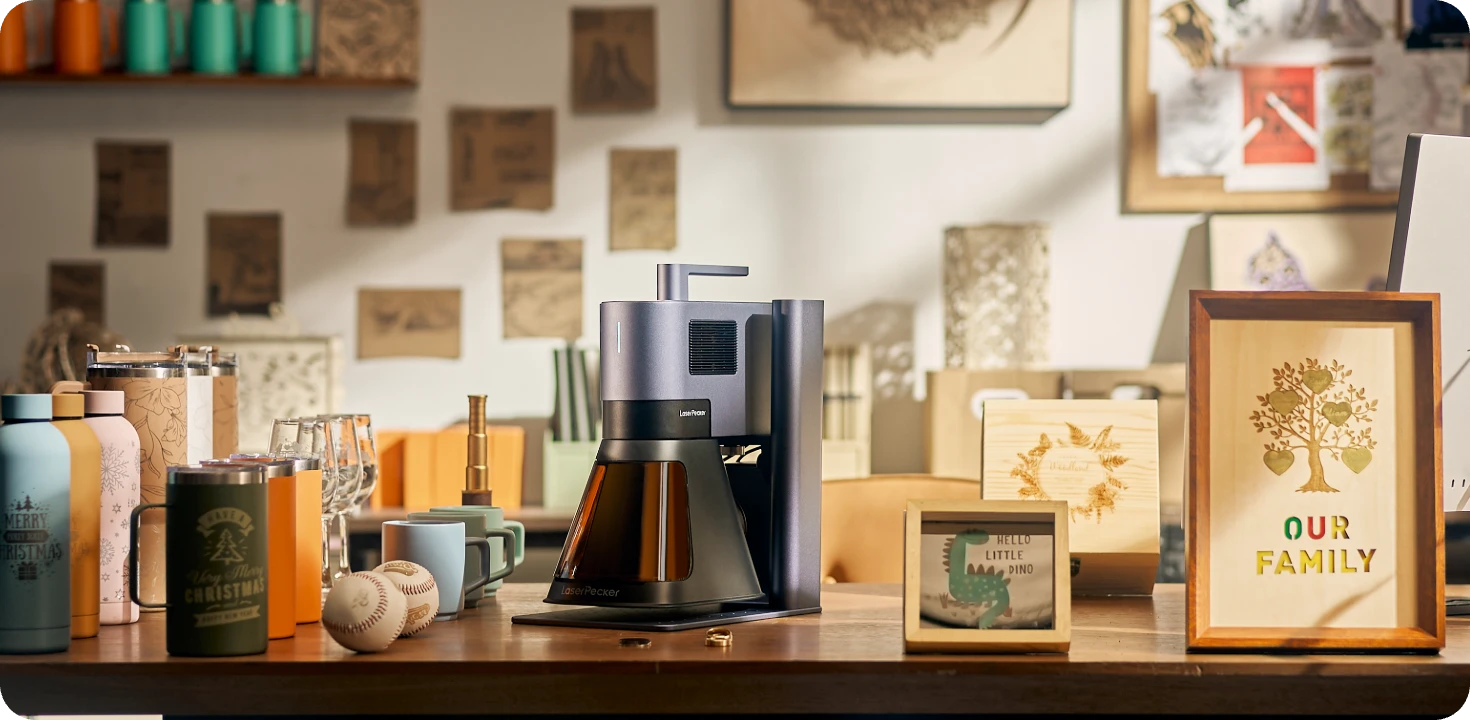
Recommended Laser Engraver for Detailed Stone Memorials: LaserPecker LP5
The LaserPecker LP5 combines a 20W blue diode laser with a 20W fiber laser. For suitable dark stone and granite surfaces, the blue diode laser can be used to create detailed surface markings, photographs, and custom memorial graphics.
Its portable laser head makes it more flexible than a fixed desktop machine when working with heavy or difficult-to-position objects. However, the LP5 is intended for detailed surface engraving rather than the deep lettering produced by an industrial CNC router or sandblasting system. Always test the actual stone before processing the finished memorial.
Dual-Laser System: A 20W blue diode laser handles suitable stone and many non-metal materials, while the 20W fiber laser is designed primarily for metal engraving.
Detailed Image Processing: Digital control supports fine text, portraits, photographs, and intricate memorial artwork.
Portable Laser Head: The removable 3.36 kg laser head can simplify positioning around large or heavy workpieces.
High-Speed Engraving: A maximum engraving speed of up to 10,000 mm/s supports efficient processing, although the practical speed depends on the material and desired result.
Flexible Software: The LP5 works with LaserPecker Design Space on mobile and desktop devices and is also compatible with LightBurn.
Material Testing: Power, speed, resolution, and line interval can be adjusted to find suitable settings for each stone sample.
FAQs: Hot Questions about Headstone Engraving Machine
Q1. What machines are used to engrave headstones?
Headstones are commonly engraved with CNC stone routers, impact engraving machines, laser engravers, or sandblasting systems. CNC and sandblasting are generally used for deep lettering, while impact and laser machines are better suited to portraits, photographs, and detailed surface designs.
Q2. What is the best engraving machine for granite headstones?
The best machine depends on the required result. Choose CNC or sandblasting for deep, tactile lettering; impact engraving for dot-based portraits on polished granite; and laser engraving for fine text, photographs, and intricate surface artwork. Many memorial businesses combine two or more methods.
Q3. Can a laser engraving machine engrave a headstone?
Yes. A suitable laser can engrave detailed surface designs on many granite headstones, particularly polished black or dark granite. The laser normally creates a light gray or white mark rather than a deep groove. Because granite varies in color and mineral composition, test a sample before engraving the finished headstone.
Q4. What is the difference between CNC, laser, impact, and sandblast headstone engraving?
CNC machines remove stone with a cutting tool and can create deep or dimensional designs. Lasers use focused light for precise, non-contact surface engraving. Impact machines form images from thousands of mechanically engraved dots. Sandblasting directs abrasive media through a stencil to produce deep traditional lettering and bold graphics.
Q5. Which machine is best for engraving photos on granite headstones?
Laser and impact engraving machines are usually the strongest options for photographs. Laser engravers provide fine digital control and non-contact processing, while impact engravers create grayscale images from engraved dots. Both generally work best on polished dark granite with good natural contrast.
Q6. How deep can a headstone engraving machine engrave?
Depth varies by machine, stone, tooling, and design. Laser and impact machines mainly create shallow surface markings. CNC routers and sandblasting systems can produce deeper, tactile carvings, but there is no universal depth suitable for every headstone. The stone thickness, structural condition, letter size, and required finish must all be considered.
Conclusion
Choosing the right headstone engraving machine starts with the result you need. CNC routers and sandblasting systems are strong choices for deep lettering and traditional memorial designs. Impact engravers and laser machines are better suited to portraits, photographs, fine text, and detailed surface artwork.
Before buying a machine, compare its working area, stone compatibility, engraving depth, image quality, safety requirements, software, maintenance, and total operating cost. Most importantly, request a test on the same stone type and surface finish used in your projects. For businesses that need both deep lettering and detailed portraits, combining multiple engraving methods may provide the most flexible workflow.


