














A picture mat board enhances both the look and protection of your artwork by creating a clean border and preventing contact with the glass. The key to a professional finish lies in precise cutting—clean edges and sharp corners make all the difference.
In this guide, we'll cover four effective methods, from simple tools to advanced machines, so you can choose the right approach for your needs.

In this article:
Method 1: Cut Picture Mat Board via Manual Cutting
Manual cutting is a simple and cost-effective way to cut picture mat boards, making it ideal for beginners and small DIY framing projects. With basic tools and careful handling, you can create clean and customized openings without using advanced machines.
Steps to Cut Picture Mat Board Manually
- Measure and Mark: Use a ruler and pencil to mark the outer size and inner window opening on the mat board.
- Align a Straight Edge: Place a metal ruler or straight edge along your cutting line to guide the blade.
- Cut the Outer Edges: Use a sharp craft knife to cut along the outer boundary with steady pressure.
- Cut the Window Opening: Carefully cut the inner window, ideally at a slight angle (bevel cut) for a professional look.
- Remove the Center Piece: Gently lift out the cut section once all sides are fully cut.
- Refine Edges: Trim or clean up any rough edges for a smooth finish.
This method works best for simple designs and small quantities. While it requires precision and patience, it remains a practical choice for custom framing without specialized equipment.
Method 2: Cut Picture Mat Board Using a Mat Cutter
Using a mat cutter is a more precise and efficient method for cutting picture mat boards. Designed specifically for framing work, mat cutters help you achieve clean, straight lines and consistent bevel cuts with greater control than manual tools.
Steps to Cut Picture Mat Board Using a Mat Cutter
- Measure and Mark: Mark the outer dimensions and inner window opening on the back of the mat board.
- Set Up the Mat Cutter: Adjust the guide rail and blade depth according to your measurements.
- Align the Board: Position the mat board securely against the cutter's guides to ensure accuracy.
- Make the Cuts: Use the mat cutter to cut each side of the window opening, applying steady and even pressure.
- Complete the Window: Carefully finish all four sides and remove the center piece.
- Check and Refine: Inspect the edges and make minor adjustments if needed for a clean finish.
This method is ideal for achieving professional-quality results, especially for projects that require consistent sizing and clean bevel edges. It is well-suited for hobbyists, photographers, and framing applications.
Method 3: Cut Picture Mat Board with a Laser Cutter
Using a laser cutter is the most precise and efficient method for cutting picture mat boards. Unlike manual tools, a laser uses a focused beam to cut along digital paths, producing clean edges and highly accurate shapes with minimal effort.
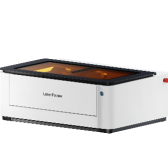
Recommended Laser Cutter for Picture Mat Board: LaserPecker LX2
Desktop laser cutters like the LaserPecker LX2 show how modern laser technology can simplify and elevate picture mat board cutting. With integrated cutting and engraving capabilities, the LX2 enables a smooth workflow from digital design to finished mat, improving both accuracy and efficiency.
-
Ultra-Fine Laser Spot
The LX2's ultra-fine laser spot ensures clean, precise cuts on mat boards. This is especially important for sharp window openings, fine borders, and detailed layouts, delivering a professional framing finish. -
Multiple Laser Choices (450nm Diode + 1064nm IR)
When working with picture mat boards and related materials, flexibility matters. The multiple laser system allows you to process not only mat board but also wood, acrylic, and other materials for creative framing or layered designs. -
Software-Controlled Precision & Batch Consistency
For framing projects that require consistent sizing, the LX2 uses software-controlled paths to ensure every cut is identical. This is ideal for producing multiple mats with the same dimensions and alignment. -
Large Working Area (Up to 500 mm × 305 mm)
The spacious work area allows you to cut larger mat boards or process multiple pieces at once. This improves efficiency and helps maintain accurate positioning for multi-window or batch cutting tasks.

Steps to Cut Picture Mat Board with a Laser Cutter
- Create Your Design: Use vector design software to define the outer dimensions and window openings.
- Import the File: Load your design into the laser cutting software and position it on the workspace.
- Prepare the Material: Place the mat board flat on the laser bed and secure it if necessary.
- Adjust Settings: Set the appropriate power, speed, and passes based on the board thickness.
- Run the Cutting Process: Start the laser to cut the mat board precisely along the design path.
- Remove and Inspect: Take out the finished piece and check for clean edges and accurate cuts.
This method is ideal for intricate layouts, repeated designs, and professional framing work. It ensures consistent results, reduces manual errors, and significantly improves production efficiency.
FAQs: Hot Questions about Cutting Picture Mat Board
Q1. Can I use a regular utility knife to cut mat board?
Yes, a utility knife can be used for simple, straight cuts on mat board, especially for basic DIY projects. It's important to use a sharp blade and apply steady, even pressure to avoid tearing.
However, for beveled window openings and more precise results, a dedicated mat cutter is recommended. It maintains the correct cutting angle and improves consistency, especially for repeated or detailed work.
Q2. How do I choose the right mat board thickness?
Mat boards typically come in 4-ply and 8-ply thicknesses. A 4-ply board is the most common choice for everyday framing, suitable for photos and standard prints.
An 8-ply board creates a deeper, more dramatic border and is often used for gallery-style presentations. The right choice depends on your artwork size, frame depth, and the visual effect you want to achieve.
Keep in mind that thicker boards require more precise cutting tools and slightly deeper blade or laser settings.
Q3. What is the best tool for cutting a picture mat?
The best tool depends on your project needs. For DIY use, a manual mat cutter offers a good balance of cost and accuracy. For higher-volume or professional work, CNC machines provide automation and consistent precision.
If you need both high precision and creative flexibility—such as custom shapes or engraved details—laser cutters are the most versatile option.
Q4. Can I cut a mat board without a professional mat cutter?
Yes, you can cut mat board using a sharp knife and ruler, but achieving clean, beveled edges can be challenging without proper tools. This method requires practice and may lead to more errors.
If you plan to do framing regularly, investing in a mat cutter or a machine-based solution will save time and significantly improve your results.
Conclusion
Cutting picture mat board requires precision, and the best method depends on your budget and project needs—from simple manual tools to advanced machines like CNC or laser cutters.
Manual methods are affordable and beginner-friendly, while machine-based options deliver greater accuracy and efficiency. Laser cutting offers the highest precision and design flexibility. Choosing the right approach ensures clean, professional results for any framing project.