


A jigsaw puzzle making machine turns printed images, artwork, or plain sheet materials into interlocking puzzle pieces. Depending on the machine, you can make cardboard photo puzzles, detailed wooden puzzles, educational products, personalized gifts, and branded merchandise.
However, no single puzzle maker machine is right for every production setup. Die cutters are efficient for producing large quantities of identical cardboard puzzles, while laser cutters offer greater flexibility for custom designs. CNC routers are better suited to thicker wood and other rigid materials.
In this guide, we compare the main types of puzzle making machines, explain their advantages and limitations, and show you how to choose a machine based on your materials, production volume, design requirements, and budget.

In this article:
- Part 1: What is a Jigsaw Puzzle Making Machine
- Part 2: 3 Types of Jigsaw Puzzle Making Machine
- Type 1: Die Cutting Machines
- Type 2: Laser Cutting Machines
- Type 3: CNC Router Machines
- Part 3: Why Laser Cutting Machine is the Best Jigsaw Puzzle Making Machine
- FAQs: Hot Questions about Jigsaw Puzzle Making Machine
Part 1: What Is a Jigsaw Puzzle Making Machine?
A jigsaw puzzle making machine is a device that cuts printed or unprinted materials into individual interlocking puzzle pieces. Common puzzle materials include cardboard, paperboard, plywood, solid wood, MDF, and certain types of acrylic.
The production process usually begins by printing, transferring, or engraving an image onto the material. A puzzle cutting machine then follows a fixed die or digital cutting path to create the individual pieces. Accurate cutting is essential because each piece must fit smoothly without being too loose or difficult to assemble.
Different machines serve different production needs. Die cutting machines are commonly used for high-volume cardboard puzzles. Laser cutters are suitable for customized shapes, detailed wooden puzzles, and short production runs, while CNC routers can cut thicker and harder materials.
A complete puzzle-making setup may also require a printer, heat press, laminator, cutting file, positioning jig, dust or fume extraction system, and packaging equipment. Therefore, the cutting machine is important, but it is only one part of the overall workflow.

Part 2: 3 Types of Jigsaw Puzzle Making Machines
The most common puzzle making machines use one of three cutting methods: die cutting, laser cutting, or CNC routing. Each method offers a different balance of production speed, design flexibility, material compatibility, cutting detail, and operating cost.
Die cutting is generally preferred for high-volume production of identical cardboard puzzles. Laser cutting works well for customized puzzles and intricate designs, while CNC routing is suited to thicker wooden and plastic puzzles.
Type 1: Die Cutting Machines for Jigsaw Puzzles
A die cutting machine uses a pre-made metal die to press puzzle shapes into cardboard, paperboard, or other relatively thin materials. Commercial puzzle manufacturers commonly use this method to produce large quantities of puzzles with the same piece layout.
Once the die has been manufactured and installed, the machine can repeatedly cut the same design quickly and consistently. However, every new puzzle layout requires a different die, increasing the setup time and cost for customized or frequently changing designs.
Pros:
- Fast Mass Production: Cuts large quantities of identical cardboard puzzles efficiently.
- Consistent Results: Produces the same piece layout during every cutting cycle.
- Low Per-Unit Cost at Scale: The cost of the die is distributed across a large production run.
Cons:
- High Setup Cost: Each puzzle layout requires a custom metal die.
- Limited Design Flexibility: Changing the piece pattern requires another die.
- Unsuitable for Small Custom Orders: Setup costs may be difficult to justify for short runs.
Type 2: Laser Cutting Machines for Jigsaw Puzzles
Laser cutting machines use a focused laser beam to cut puzzle pieces directly from a digital design. Because no physical die is required, users can change the puzzle size, piece count, edge shape, or artwork without replacing cutting hardware.
A laser puzzle cutter machine is particularly useful for customized wooden puzzles, prototypes, educational products, irregular piece designs, and small to medium production runs. Depending on the laser source and power, compatible materials may include plywood, MDF, cardboard, paperboard, and certain acrylics.
Laser cutting is a thermal process, so settings, airflow, focus, and material selection must be tested carefully. Wood and cardboard may develop darkened edges, while some plastics are unsafe or unsuitable for laser processing.
Pros:
- High Precision: Creates detailed puzzle patterns and accurately fitting pieces.
- No Physical Die: Designs can be changed directly in the software.
- Excellent for Customization: Suitable for personalized puzzles, prototypes, and short production runs.
- Non-Contact Cutting: The cutting head does not mechanically press against the material.
- Cutting and Engraving: Many systems can engrave artwork and cut the puzzle in one workflow.
Cons:
- Slower for Mass Production: Die cutting is usually more efficient for very large runs of one design.
- Possible Edge Darkening: Wood and cardboard may show heat marks if the settings are not optimized.
- Ventilation Required: A suitable extraction system is needed to control smoke and fumes.
Type 3: CNC Router Machines for Jigsaw Puzzles
A CNC router uses a rotating cutting bit controlled by a digital toolpath to cut puzzle shapes from wood, MDF, and certain plastics. Unlike a laser cutter, it removes material mechanically and can create deeper cuts in thick, rigid workpieces.
CNC routers are commonly used for large-format wooden puzzles, children’s shape puzzles, puzzle boards, and products that require pockets, recessed areas, or dimensional features. The final detail level depends partly on the diameter of the cutting bit.
Because the tool physically contacts the workpiece, the material must be secured firmly. Users must also consider cutting-bit wear, sawdust extraction, toolpath setup, and possible sanding after machining.
Pros:
- Suitable for Thick Materials: Cuts thick wood, MDF, and rigid plastic more effectively than many small laser systems.
- Dimensional Machining: Can create pockets, recesses, and shaped puzzle boards.
- Repeatable Digital Workflow: Saved toolpaths can be used for repeated production.
Cons:
- Limited Fine Detail: Small internal features are restricted by the cutting-bit diameter.
- Tool Wear: Bits require inspection, maintenance, and replacement.
- More Post-Processing: Some materials may require sanding or edge cleanup.
- Dust and Noise: CNC routing requires effective dust collection and produces mechanical noise.
Part 3: Which Jigsaw Puzzle Making Machine Is Best?
| Machine Type | Best For | Precision | Production Speed | Design Flexibility | Typical Materials | Main Limitation |
|---|---|---|---|---|---|---|
| Die Cutting Machine | High-volume production of one puzzle layout | Medium–High | Very High | Low | Cardboard and paperboard | A new die is required for each layout |
| Laser Cutting Machine | Custom puzzles and small to medium batches | Very High | Medium–High | Very High | Wood, MDF, cardboard, and certain acrylics | Thermal marks and ventilation requirements |
| CNC Router | Thick wooden puzzles and dimensional puzzle boards | High | Medium | High | Wood, MDF, and rigid plastic | Bit size limits fine details |
The best machine to make puzzles depends on what you plan to produce. A die cutting machine is usually the most efficient choice for thousands of identical cardboard puzzles. A CNC router is useful for thick wooden puzzles and recessed puzzle boards.
For personalized designs, frequent design changes, detailed piece shapes, and small to medium production runs, a laser cutter often provides the best balance of precision and flexibility. It eliminates the need for custom dies and allows the user to switch between digital files with relatively little setup.
Why Choose a Laser Puzzle Cutting Machine?
- Detailed Cutting: A narrow laser beam can produce intricate interlocking shapes and small internal features.
- Fast Design Changes: Puzzle layouts can be edited in the software without manufacturing another die.
- Cost-Effective Customization: Individual names, artwork, piece shapes, and puzzle sizes can be changed between jobs.
- Cutting and Engraving: Images, text, outlines, and decorative details can be engraved before the puzzle is cut.
- Broad Creative Potential: The same machine can produce photo puzzles, maps, educational puzzles, layered puzzles, and irregular wooden designs.
However, laser cutting is not automatically the best option for every business. Manufacturers producing very large quantities of one cardboard design will usually benefit more from die cutting. Buyers should compare production volume, material thickness, cutting time, ventilation, maintenance, and total workflow costs before making a decision.
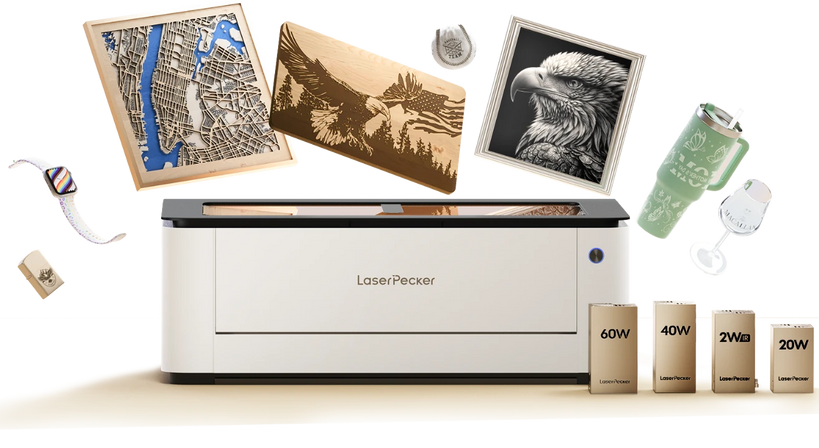
Recommended Laser Cutting Machine for Jigsaw Puzzles: LaserPecker LX2
The LaserPecker LX2 is designed for users who need to engrave artwork and cut puzzle pieces within the same digital workflow. Its 500 × 305 mm working area provides space for photo puzzles, educational products, custom maps, and small-batch wooden puzzle designs.
With 20W, 40W, and 60W blue diode laser options, plus an optional 2W infrared laser, the LX2 can support different cutting and engraving requirements. Its 12MP camera, autofocus system, and air assist are also useful for positioning artwork, maintaining focus, and improving cutting consistency.
- 500 × 305 mm Working Area: Provides practical space for medium-format puzzles and batch layouts.
- Cutting and Engraving in One Workflow: Engraves images or text before cutting the individual puzzle pieces.
- Flexible Laser Configurations: Available with 20W, 40W, or 60W blue diode laser options and an optional 2W infrared laser.
- 12MP Camera Positioning: Helps align the artwork and cutting path with the workpiece.
- Autofocus: Simplifies focus setup when switching between compatible materials.
- Integrated Air Assist: Helps remove smoke and debris from the cutting path.
- Digital Design Changes: Supports customized puzzle layouts without manufacturing physical dies.
FAQs about Jigsaw Puzzle Making Machines
Q1. What machine is used to make jigsaw puzzles?
Jigsaw puzzles are commonly made with die cutting machines, laser cutting machines, or CNC routers. Die cutters are widely used for mass-produced cardboard puzzles. Laser cutters are suitable for custom wooden and cardboard puzzles, while CNC routers are often used for thicker wooden puzzle pieces and recessed puzzle boards.
Q2. Is a laser cutter or die cutting machine better for making puzzles?
A die cutting machine is generally better for producing large quantities of identical cardboard puzzles because it offers a fast cycle time once the die is ready. A laser cutter is better for custom designs, prototypes, short runs, wooden puzzles, and businesses that frequently change the piece layout.
Q3. Can you make jigsaw puzzles with a laser cutting machine?
Yes. A laser cutter can cut interlocking puzzle pieces from compatible materials such as plywood, MDF, cardboard, paperboard, and certain acrylics. It can also engrave images, text, or decorative details before cutting. Always test the material and use appropriate ventilation, as some materials can produce excessive smoke or hazardous fumes.
Q4. What machine is best for making wooden jigsaw puzzles?
A laser cutter is often the best option for detailed wooden puzzles made from relatively thin plywood or MDF because it can create intricate shapes without a physical die. A CNC router may be more suitable for thick solid wood, large puzzle pieces, or puzzle boards that require pockets and recessed areas.
Q5. How are images printed on custom jigsaw puzzles?
Images may be applied with direct printing, sublimation, heat transfer, adhesive photo sheets, or printed paper laminated onto the puzzle board. The appropriate method depends on the puzzle material and production volume. The image is normally applied before the board is cut so that the artwork remains aligned across all pieces.
Conclusion
Choosing the right jigsaw puzzle making machine begins with your material, puzzle design, and expected production volume. Die cutting machines provide the highest efficiency for large runs of identical cardboard puzzles. CNC routers are useful for thick wooden pieces and dimensional puzzle boards, while laser cutters offer greater flexibility for detailed, customized, and frequently changing designs.
Before purchasing a machine, evaluate more than its initial price. Working area, cutting speed, software, image-positioning tools, ventilation, maintenance, material costs, and finishing requirements all affect the real cost of production.
If your business focuses on personalized wooden puzzles or small to medium production runs, a digital laser system can combine engraving and cutting in one adaptable workflow. Explore LaserPecker machines to compare available options for your puzzle-making projects.


