


A high-quality laser engraving machine for jewelry can create precise, permanent designs on rings, bracelets, pendants, charms, and other small items. Compared with hand engraving, a jewelry laser engraver offers greater speed, repeatability, and control, making it suitable for independent designers, jewelry stores, personalization businesses, and professional workshops.
However, not every engraving machine for jewelry works with the same materials. Fiber and infrared lasers are generally used for metals, while diode and CO2 lasers are better suited to materials such as wood, leather, and acrylic.
This guide explains how these machines work, compares the main laser types, and covers the key features to consider when choosing the best laser engraver for jewelry.

In this article:
- Part 1: 5 Benefits of a laser engraving machine for jewelry
- Part 2: Main types of jewelry engraving machines
- Type 1: Fiber laser engravers for jewelry
- Type 2: Infrared laser engravers for jewelry
- Type 3: Diode laser engravers for jewelry
- Type 4: CO2 laser engravers for jewelry
- Part 3: FAQ about laser engraving machine for jewelry
Part 1: 5 Benefits of a Laser Engraving Machine for Jewelry
A laser engraving machine for jewelry provides the precision, flexibility, and repeatability needed for both custom orders and small-batch production. Its main benefits include:
Benefit #1: Compatibility With Different Jewelry Materials
Depending on the laser source, jewelry engravers can process gold, silver, platinum, titanium, stainless steel, coated metals, wood, leather, acrylic, and other materials. A machine with more than one laser source can reduce the need to purchase separate equipment for metal and non-metal jewelry.
Benefit #2: High-Precision Engraving
A focused laser beam can reproduce fine text, dates, initials, logos, patterns, photos, and other detailed designs. This level of precision is especially valuable when engraving small rings, pendants, charms, and identification tags.
Benefit #3: Engraving on Curved Jewelry
With suitable positioning tools or a rotary attachment, a jewelry laser engraver can process curved items such as rings and bracelets. The correct setup helps maintain focus and alignment as the workpiece rotates.
Benefit #4: Faster Custom and Batch Production
Engraving software allows operators to save designs, reuse templates, import variable text, and repeat the same job across multiple items. This improves consistency and reduces setup time for personalized orders and batch production.
Benefit #5: Non-Contact Processing
The laser does not physically press against the jewelry. This reduces the risk of tool marks, mechanical stress, and accidental scratches, although delicate, plated, or heat-sensitive pieces still require careful testing and suitable settings.
Part 2: Main Types of Jewelry Engraving Machines
The best jewelry engraving machine depends primarily on the material you plan to process. Fiber and infrared lasers are designed for metal marking, while blue diode and CO2 lasers are generally better for organic materials, coated surfaces, and acrylic jewelry.
Type 1: Fiber Laser Engravers for Jewelry
A fiber laser is usually the best option for engraving metal jewelry. Its approximately 1064 nm wavelength is well absorbed by metals such as gold, silver, platinum, titanium, brass, and stainless steel. Depending on the machine and settings, it can produce fine surface marks, deeper engravings, textures, and high-contrast results.
A 20W fiber system such as the LaserPecker LP5 is suitable for personalized rings, pendants, bracelets, charms, and other metal items. When paired with a compatible rotary attachment, it can also process curved jewelry and the inside of suitable rings.
Type 2: Infrared Laser Engravers for Jewelry
Infrared laser engravers commonly operate near 1064 nm but generally use lower output power than dedicated fiber systems. They are suitable for fine surface marking on metals, plastics, coated items, and some delicate jewelry components.
A dual-laser machine such as the LaserPecker LP4 combines a 2W infrared laser with a 10W blue diode laser. Its infrared source can mark compatible metals, while the diode source expands the machine's use to materials such as wood and leather.
- Fine surface marking on compatible metals
- Small personalized jewelry and accessories
- Coated, plated, or delicate items that do not require deep engraving
Type 3: Diode Laser Engravers for Jewelry
Blue diode lasers commonly operate near 450 nm. They are suitable for making jewelry from wood, bamboo, leather, and certain opaque acrylics, as well as marking some coated metals. They are widely used by beginners and small craft businesses because they are generally accessible and easy to operate.
However, a standard blue diode laser is not a direct substitute for a fiber or infrared metal engraving machine for jewelry. It generally cannot engrave bare gold, silver, or stainless steel effectively without a suitable marking coating.
Type 4: CO2 Laser Engravers for Jewelry
CO2 lasers typically operate at 10,600 nm and are best suited to non-metal jewelry materials such as acrylic, wood, leather, and glass. They are particularly useful for businesses that cut and engrave acrylic earrings, pendants, and decorative components.
A conventional CO2 laser does not directly engrave most bare metals. It may mark coated or pretreated metal surfaces, but a fiber laser is generally the better choice for gold, silver, steel, and other metal jewelry.
| Laser Type | Best-Suited Materials | Metal Capability | Typical Use | Best For |
|---|---|---|---|---|
| Fiber | Gold, silver, platinum, titanium, brass, steel | Surface marking and deep engraving | Metal rings, bracelets, charms, and pendants | Professional metal jewelry engraving |
| Infrared | Compatible metals, plastics, and coated items | Primarily surface marking | Fine personalization and light-duty marking | Small studios and custom-product businesses |
| Blue Diode | Wood, leather, bamboo, and some opaque acrylics | Limited on bare metal | Craft jewelry and coated accessories | Beginners and hobbyists |
| CO2 | Acrylic, glass, wood, and leather | Requires coating or pretreatment for most metals | Cutting and engraving non-metal jewelry | Acrylic jewelry production |
Why Choose a Dual-Laser Jewelry Engraver?
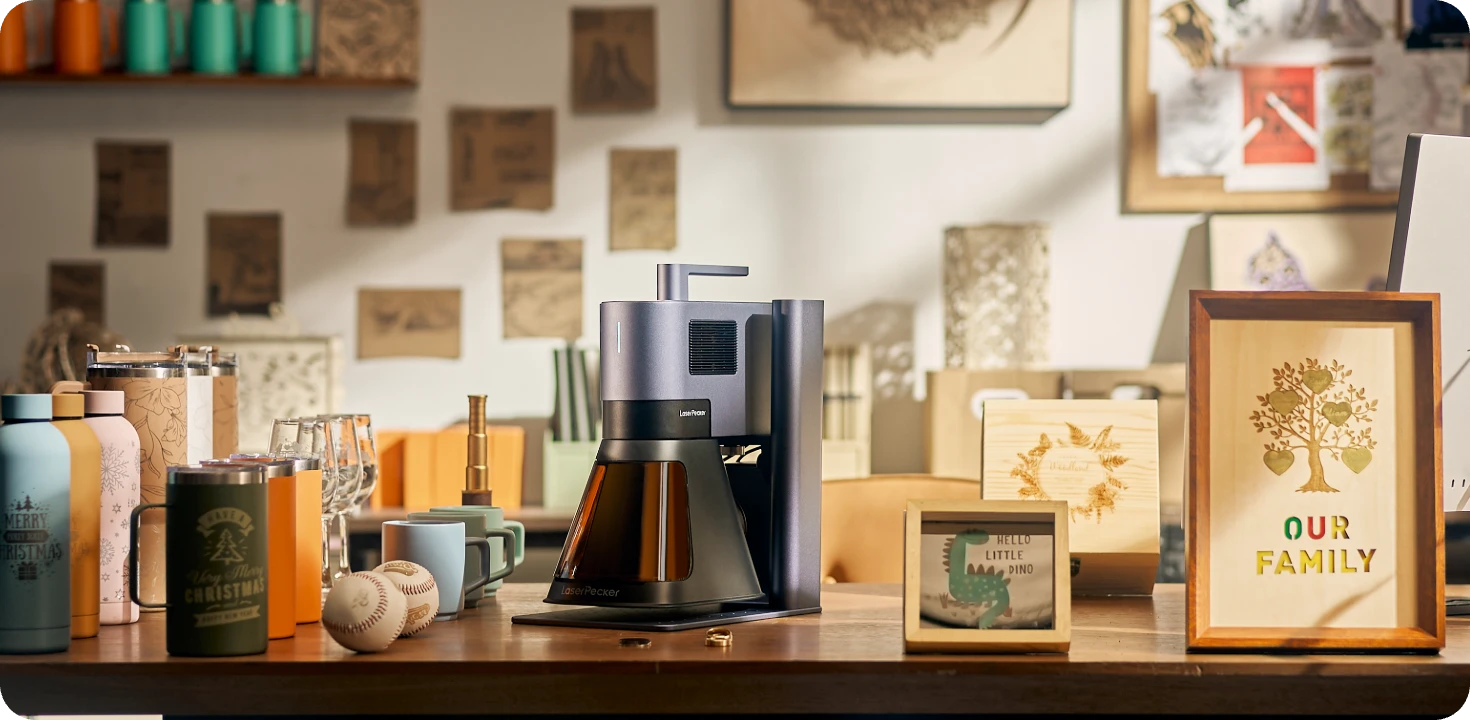
A dual-laser machine combines two laser sources to process a broader range of materials. The LaserPecker LP5, for example, integrates a 20W 1064 nm fiber laser for metals with a 20W 450 nm diode laser for materials such as wood, leather, and dark acrylic.
For jewelry businesses, this combination supports metal engraving, non-metal jewelry making, deep engraving, 3D relief engraving, variable-text production, and processing speeds of up to 10,000 mm/s. Compatible rotary and slide extensions also make it easier to handle curved jewelry and larger batches.
A dual-laser system is a practical choice for studios that regularly work with both metal and non-metal products. A dedicated fiber laser may still be more appropriate for businesses focused exclusively on continuous, high-volume metal production.
Part 3: FAQs About Laser Engraving Machines for Jewelry
Q1. What type of laser engraver is best for jewelry?
A fiber laser is generally the best choice for gold, silver, platinum, titanium, brass, and stainless steel jewelry.
An infrared laser is suitable for fine surface marking and lighter-duty personalization, while diode and CO2 lasers are better for jewelry made from wood, leather, acrylic, or other non-metal materials.
For businesses working with both metal and non-metal products, a dual-source jewelry laser engraver offers greater flexibility.
Q2. Can a laser engraver engrave gold and silver jewelry?
Yes. A fiber or compatible infrared laser can engrave gold and silver jewelry. The correct power, speed, frequency, focus, and number of passes depend on the alloy, surface finish, thickness, and desired engraving depth. Because gold and silver items can be valuable and may contain different alloys or coatings, always test the settings before processing the finished piece.
Q3. How many watts does a laser engraver need for jewelry?
For light surface marking on small metal jewelry, a low-power infrared laser may be sufficient. A 20W fiber laser offers more flexibility for professional marking, deeper engraving, textures, and faster production. Higher wattage can improve processing speed and depth, but beam quality, pulse control, material compatibility, and suitable settings are just as important as power.
Q4. Is a fiber laser or diode laser better for jewelry engraving?
A fiber laser is better for bare metal jewelry such as gold, silver, brass, titanium, and stainless steel. A blue diode laser is better for wood, leather, bamboo, and some opaque acrylic jewelry, but it has limited effectiveness on bare metals. Choose according to the material rather than wattage alone.
Q5. Can a laser engraver engrave the inside of a ring?
Yes, some laser engraving machines can engrave the inside of a ring when used with a compatible rotary attachment and suitable ring fixture. The ring must be securely positioned, correctly focused, and rotated in alignment with the design. Machine clearance and the ring's diameter, width, profile, and material also affect compatibility.
Q6. Do you need a rotary attachment to engrave rings and bracelets?
A rotary attachment is not always required for a small design on a flat or nearly flat section. However, it is generally recommended for designs that extend around a ring or bracelet, as well as for engraving the inside of a ring. The attachment rotates the jewelry to help maintain focus and consistent spacing across the curved surface.
Conclusion
Choosing the best laser engraver for jewelry starts with the materials you plan to process. A fiber laser is generally the best choice for metal jewelry, while diode and CO2 systems are better suited to wood, leather, acrylic, glass, and other non-metal materials.


