


Metal engraving tools are widely used in jewelry making, watchmaking, industrial marking, and custom product creation. Choosing the right tool can significantly improve the quality, speed, and precision of your work.
In this guide, we’ll explain the main types of engraving tools for metal and how to choose the right one based on your project, material, desired finish, and production needs. Whether you are a professional or a beginner, this guide will help you find the best metal engraver for your work.

In this article:
- Part 1: Metal Laser Engraving Machines
- Type 1: Blue Diode Laser Engraver
- Type 2: IR Laser Engraver
- Type 3: Fiber Laser Engraver
- Part 2: CNC Metal Engraving Machines
- Part 3: Hand Metal Engraving Tools
- Part 4: Electric Metal Engraving Tools
- Part 5: How to Choose the Metal Tool Engraver
- Part 6: FAQ about Metal Engraving Tools
Part 1: Metal Laser Engraving Machines
Metal laser engraving machines use a focused beam to mark, engrave, or cut compatible metals. They offer high precision and are ideal for detailed designs that are difficult to create by hand. These machines can support applications ranging from small custom projects to industrial production. The best laser engraver for metal depends on the material and the required engraving depth and detail.
Benefits of Metal Laser Engraving
- High Precision: Creates fine lines, detailed images, and clear text.
- Non-Contact Process: Applies no physical pressure to the workpiece and eliminates cutting-tool wear.
- Fast and Consistent: Produces repeatable results across multiple items.
- Versatile Applications: Works with different metals and other materials, depending on the laser source.
Type 1: Blue Diode Laser Engraver
Blue diode lasers work best on coated metals, including painted, powder-coated, and anodized surfaces. They typically remove or alter the coating to reveal a contrasting design but are generally less effective for engraving directly into bare metal.
Type 2: IR Laser Engraver
IR laser engravers can mark many bare metals without requiring a coating. They are suitable for materials such as stainless steel and aluminum and can produce clean, durable surface marks.
Type 3: Fiber Laser Engraver
Fiber laser engravers are more powerful and commonly available with an output of 20W or higher. They can produce deeper engravings and, depending on the machine and material, cut thin metal. Compared with compact IR laser engravers, fiber lasers generally offer faster processing and greater engraving depth, making them suitable for durable markings and professional production.
Best Metal Laser Engraving Machine
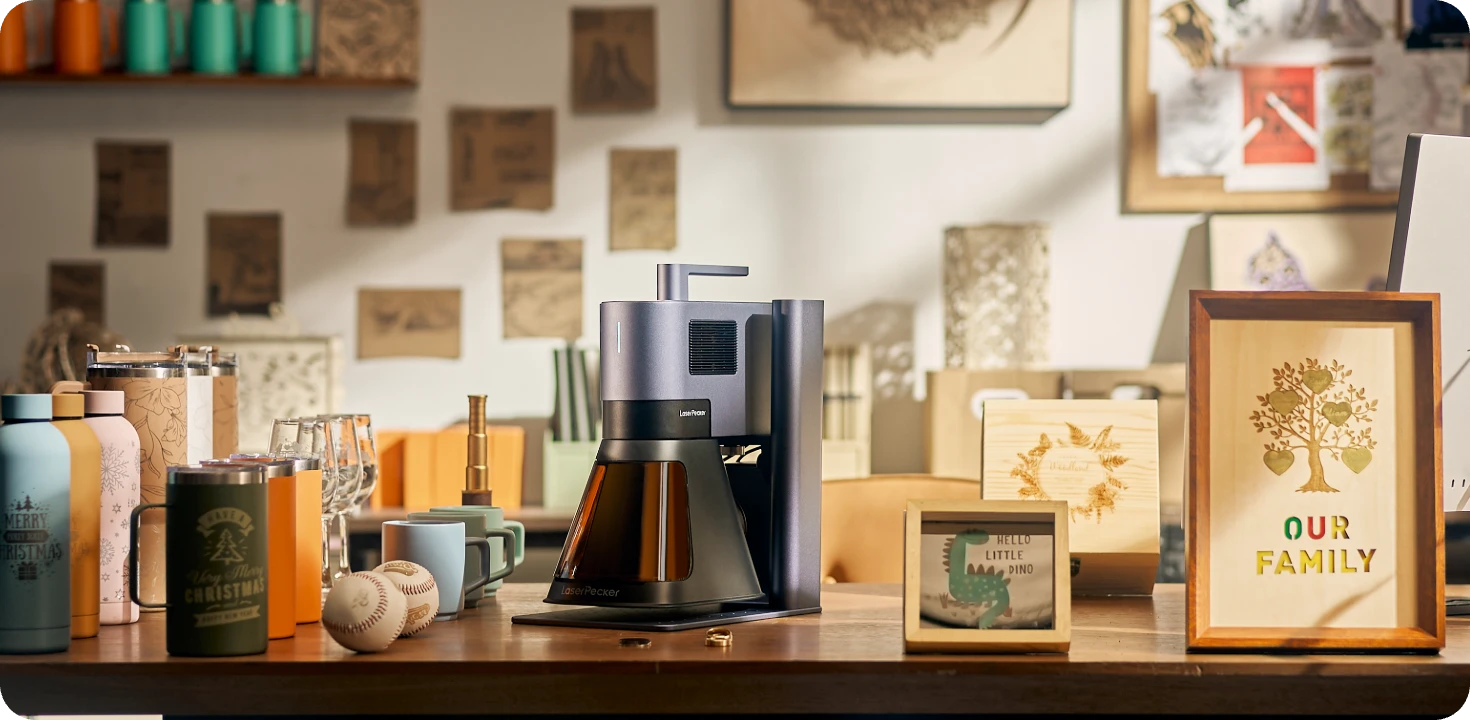
The LaserPecker LP5 is a compact and versatile laser engraver for metal. Its 20W 1064 nm fiber laser and 20W 450 nm diode laser allow it to process both bare and coated metals, as well as a range of nonmetal materials. Its key features include:
- Compact and Powerful: Its portable design is suitable for studios, workshops, and mobile projects.
- Fast Engraving: Reaches engraving speeds of up to 10,000 mm/s for efficient customization and batch production.
- Deep Metal Engraving: Creates durable, recessed designs on compatible metals.
- 3D Coin Engraving: Produces detailed 3D relief designs on coins and other suitable metal objects.
- Thin Metal Cutting: Cuts selected thin metal sheets within the machine’s supported material and thickness limits.
- Color Marking: Creates color effects on compatible stainless-steel surfaces.
- Optional Accessories: Supports a 160 × 300 mm Slide Extension and a rotary attachment for cylindrical and ring-shaped objects.
- Compatible Software: Works with LaserPecker Design Space and LightBurn.
- Safer Indoor Operation: A compatible Class 1 Safety Enclosure provides laser-light filtering, door detection, and exhaust support.
Part 2: CNC Metal Engraving Machines
CNC metal engraving machines follow digital designs to cut or engrave metal with high precision. They can repeatedly produce identical results, making them suitable for serial numbers, logos, and batch production. CNC engraving tools for metal can also create complex 2D and 3D designs that would be difficult to produce by hand, making them useful for both hobbyists and professional workshops.
Benefits of CNC Metal Engraving
- Automation: Reduces manual labor and operator error.
- Consistency: Produces uniform results for serial numbers, branded products, and batch production.
- Complex Designs: Creates detailed 2D and 3D designs that are difficult to produce manually.
- Scalability: Supports both small projects and larger production runs.
Part 3: Hand Metal Engraving Tools
Hand engraving requires skill and practice. Engravers use tools such as burins and chisels to create designs directly on metal. This method allows artists to produce unique details and textures that are difficult to replicate with a machine. Although it takes longer than machine engraving, it offers greater control over line depth and appearance, making it ideal for custom jewelry and decorative metalwork.
Benefits of Hand Metal Engraving
- Artistic Freedom: Creates unique textures, patterns, and decorative details.
- Personalization: Gives each engraved piece a distinctive handmade appearance.
- Direct Control: Provides precise control over line depth and quality.
Part 4: Electric Metal Engraving Tools
Electric metal engraving tools use vibrating or rotating tips to make engraving easier and faster. They reduce hand fatigue and are well suited to small projects, simple designs, and repetitive work. Many electric engravers support interchangeable tips for different engraving effects, offering a practical balance between manual control and efficiency.
Benefits of Electric Metal Engraving
- Less Fatigue: Requires less manual effort than traditional hand engraving.
- Faster Engraving: Works well for repeated designs and minor adjustments.
- Interchangeable Tips: Supports different tips for a range of engraving effects.
Part 5: How to Choose a Metal Engraving Tool?
Choosing the right metal engraving tool depends on the material, required engraving depth, production volume, budget, and level of precision. Hand tools are best suited to detailed artistic work, while laser and CNC machines are more efficient for professional or production applications. Understanding the strengths of each method will help you achieve better results.
Consideration #1: Material Compatibility
When choosing a metal engraving tool, consider the type of metal you plan to process, such as stainless steel, aluminum, brass, or coated metal.
- Blue diode lasers work best on painted, powder-coated, or anodized metal surfaces.
- IR lasers are suitable for marking many bare metals.
- Fiber lasers are ideal for faster, deeper, and more durable engraving on compatible metals.
Other tools have different strengths:
- Hand engraving tools can create artistic designs on various metals, but they require practice and are slow for large projects.
- Electric engravers are easy to use for small tasks and quick adjustments, but they are less suitable for deep or highly precise engraving on hard metals.
- CNC engraving machines provide consistent results on bare metals but require more setup, space, and investment, making them less practical for some hobbyists and small projects.
Understanding these differences will help you choose the right tool for your material, design, and production volume.
Consideration #2: Depth and Durability
Consider how deep and durable the engraving needs to be. Hand tools, electric engravers, and compact laser engravers can create decorative or surface-level marks. For deeper, more durable engraving, a fiber laser or CNC machine is generally a better choice.
Consideration #3: Budget and Production Volume
Consider your budget and expected production volume. Hand and electric tools are affordable options for hobbies and small projects. CNC machines and fiber laser systems require a larger investment but are better suited to professional work and higher-volume production.
Consideration #4: Precision and Detail Requirements
Consider the level of detail required by your design. Laser engravers and CNC machines deliver high precision and repeatability, while hand tools provide greater artistic control and a distinctive handcrafted appearance.
Part 6: FAQ About Metal Engraving Tools
Q1. What tools can you use to engrave metal?
You can engrave metal with hand gravers, chisels, electric engraving pens, rotary tools, CNC machines, and laser engravers. Hand and electric tools are suitable for custom or small projects, while CNC and laser systems offer greater precision and repeatability for professional production.
Q2. What is the best metal engraving tool for beginners?
An electric engraving pen or rotary tool is an affordable choice for beginners creating simple freehand designs. For clean text, logos, and repeatable digital designs, a compact laser engraver is generally easier to control and produces more consistent results.
Q3. Can you engrave metal with a Dremel or rotary tool?
Yes. A Dremel or similar rotary tool can create names, outlines, patterns, and shallow engravings on many metals. Use a suitable bit, secure the workpiece, and make light passes to maintain control and achieve a cleaner finish.
Q4. What is the difference between metal engraving and etching?
Metal engraving removes material to create a recessed design. Etching changes or removes the surface through a chemical, electrochemical, or laser-based process and usually produces a shallower mark. However, the terms “laser engraving” and “laser etching” are sometimes used differently depending on the process and manufacturer.
Q5. What type of laser is best for engraving metal?
A fiber laser is generally the best choice for fast, deep, and durable engraving on bare metal. A 1064 nm IR laser is suitable for surface marking on many metals, while a blue diode laser works best on painted, powder-coated, or anodized metal. The LaserPecker LP5 combines a 20W fiber laser and a 20W diode laser, allowing it to process both bare and coated metals.
Q6. Can one engraving tool work on all types of metal?
No. Metal hardness, surface coating, reflectivity, and the required engraving depth all affect tool compatibility. A tool that works well on coated aluminum may not produce the same result on bare stainless steel, brass, or another metal. Always check material compatibility and test the settings first.
Q7. How do you choose the right metal engraving tool?
Choose a metal engraving tool based on the material, required depth, design detail, production volume, budget, and desired level of automation. Hand and electric tools suit artistic or small projects, CNC machines provide controlled mechanical engraving, and laser engravers deliver precise, repeatable results.
Conclusion
The best metal engraving tool depends on the material, required depth, design detail, production volume, and working method. Hand engraving tools provide artistic control, electric engravers offer an affordable entry point, CNC machines create controlled physical depth, and laser engravers deliver fast, precise, and repeatable results.
If you work with both bare and coated metals, a dual-source metal engraver such as the LaserPecker LP5 provides greater flexibility than a single-laser system. Whatever equipment you choose, confirm material compatibility, secure the workpiece, test the settings, and follow the appropriate safety procedures before starting the final project.


