


Choosing the right leather cutting machine or hand tool can make the difference between clean, accurate pieces and uneven edges that waste valuable material. Because leather varies in thickness, firmness, grain, and finish, a tool that works well for soft garment leather may not be suitable for thick vegetable-tanned hides.
In this guide, we compare the best leather cutting tools for different users and production needs, including laser cutters, CNC knife cutters, manual leather knives, and rotary cutters. Whether you are making wallets at home, developing custom patterns, or running a leather goods business, this comparison will help you choose the right tool for your workflow.

In this article:
- Part 1: What Are Leather Cutting Tools?
- Part 2: Four Best Cutting Tools for Leather
- Type 1: Laser Cutting Machine for Leather
- Type 2: CNC Leather Cutters
- Type 3: Manual Leather Knives
- Type 4: Handheld Rotary Cutters
- Part 3: How to Choose the Right Leather Cutting Tool for You?
- Part 4: Common Leather Cutting Mistakes to Avoid
- Part 5: FAQs about Leather Cutting Tool
Part 1: What Are Leather Cutting Tools?
Leather cutting tools include handheld blades and powered machines designed to cut leather into specific sizes, patterns, and shapes. Common options range from utility knives and rotary cutters to die-cutting presses, CNC knife systems, and laser cutting machines.
The best tool depends on the leather type, thickness, pattern complexity, production volume, and desired edge finish. A sharp knife may be the best leather cutting tool for a simple one-off project, while a digital leather cutter is usually more practical for intricate designs or repeated production.
Unlike paper or ordinary fabric, leather can vary across the same hide. Its grain, firmness, stretch, surface coating, and natural imperfections can all affect the cut. For this reason, users should inspect the material, secure it properly, and test the cutting method before processing the final piece.
Part 2: Four Best Cutting Tools for Leather
There is no single best leather cutting tool for every project. The right choice depends on whether you prioritize affordability, cutting detail, repeatability, material thickness, or production speed. Below are four widely used options and the applications each one handles best.
Type 1: Laser Cutting Machine for Leather
A leather laser cutting machine uses a focused beam and a digital design file to cut without touching the material. Because there is no blade pressure, the process can produce detailed curves, small openings, repeated shapes, and engraved graphics without mechanically stretching the leather.
A laser cutter for leather is especially useful for personalized goods because the same machine can cut an outline and engrave names, logos, patterns, or alignment marks. Once the file and settings have been tested, the design can also be reproduced consistently.
Advantages:
- Produces precise curves, openings, and intricate patterns.
- Supports repeatable cutting from digital design files.
- Applies no blade pressure to the leather.
- Can combine cutting and engraving in one workflow.
- Makes it easy to resize or modify custom designs.
Limitations and safety considerations:
- Heat may darken or char the cut edge, especially on light-colored leather.
- Settings must be tested for each leather type and thickness.
- Effective exhaust and ventilation are required to remove smoke and odors.
- Never laser-cut PVC or vinyl-based synthetic leather.
- Do not process unidentified leather or coated material until its composition has been confirmed with the supplier or safety data.
Laser machines are well suited to custom wallets, patches, earrings, labels, decorative panels, prototypes, and small-batch leather goods.
Type 2: CNC Leather Cutters
CNC leather cutters use computer-controlled blades—often oscillating, drag, or rotary tools—to follow digital patterns. Unlike a laser, the blade cuts mechanically without creating a heat-affected edge.
The leather is placed on a cutting bed and secured, often by a vacuum system. After the pattern file is loaded, the machine follows the programmed path and can reproduce parts efficiently. Industrial systems may also support marking, punching, nesting, and multiple cutting tools.
Advantages:
- Cuts without creating a laser-darkened edge.
- Handles large sheets and production-scale patterns.
- Offers high repeatability for batch manufacturing.
- Can process materials that may not be suitable for laser cutting.
Limitations:
- Industrial systems require substantial floor space and investment.
- Blades wear and require replacement or maintenance.
- Fine internal details may be limited by blade size and turning radius.
- Setup and operation can be excessive for occasional home projects.
CNC knife systems are most practical for factories, upholstery businesses, footwear manufacturers, and workshops processing large leather panels or high order volumes.
Type 3: Manual Leather Knives
Manual leather cutting tools include utility knives, craft knives, head knives, round knives, and specialized pattern knives. They cut through direct hand pressure and give experienced users close control over the cutting path.
To make a clean cut, place the leather on a cutting mat, mark the pattern, secure a ruler or template, and use a sharp blade. Several controlled passes are usually safer and more accurate than forcing a dull blade through thick leather in one pass.
Advantages:
- Affordable and easy to replace or maintain.
- Requires no electricity, software, or machine setup.
- Offers good control for straight cuts and traditional leatherwork.
- Works well for prototypes, repairs, and one-off pieces.
Limitations:
- Cut quality depends on blade sharpness and user skill.
- Repeated parts can be difficult to keep identical.
- Complex patterns take more time to cut by hand.
- Poor technique or a dull blade increases the risk of slips and uneven edges.
A sharp utility or craft knife is often the most practical starting point for beginners, while head and round knives are better suited to users who have developed the required sharpening and cutting skills.
Type 4: Handheld Rotary Cutters
A handheld rotary cutter uses a circular blade that rolls across the leather. This smooth rolling action makes it efficient for long lines, broad curves, and repeated pattern preparation, particularly on relatively thin and flexible leather.
Place the material on a cutting mat, align a ruler or template, and guide the cutter with steady pressure. Although rotary cutters are usually faster than craft knives on long cuts, they are less suitable for tight corners and small internal details.
Advantages:
- Cuts long straight lines quickly.
- Provides smooth movement across thin leather.
- Works well with rulers and large pattern templates.
- Requires little setup and no software.
Limitations:
- Does not handle tight corners or tiny details well.
- May struggle with very thick or rigid hides.
- Still requires careful pressure and hand control.
- Cannot engrave or digitally reproduce a design.
Rotary cutters are a practical choice for straps, panels, linings, and pattern pieces with long edges or gradual curves.
Comparison of Leather Cutting Tools
| Tool Type | Precision | Learning Curve | Best For | Edge Characteristics | Production Scale |
|---|---|---|---|---|---|
| Laser Cutting Machines | Very high | Moderate | Detailed designs, personalization, repeatable batches | May be darkened or heat-sealed | Small to medium production |
| CNC Leather Cutters | High | Moderate to high | Large panels and industrial production | Blade-cut, no heat discoloration | Medium to very high production |
| Manual Leather Knives | Skill-dependent | Low to high | One-off projects and traditional leatherwork | Clean when the blade and technique are good | Low production |
| Rotary Cutters | Medium | Low | Long lines and gentle curves | Clean on compatible leather | Low production |
Manual knives and rotary cutters are affordable and flexible, making them practical for simple projects and low-volume work. However, accuracy and repeatability depend heavily on the user.
CNC knife cutters are better suited to large sheets and industrial output, while laser machines offer a strong balance of detail, customization, and repeatability for makers and small businesses.
For users who want to cut and personalize leather in the same digital workflow, LaserPecker LX2 provides a larger desktop cutting platform.
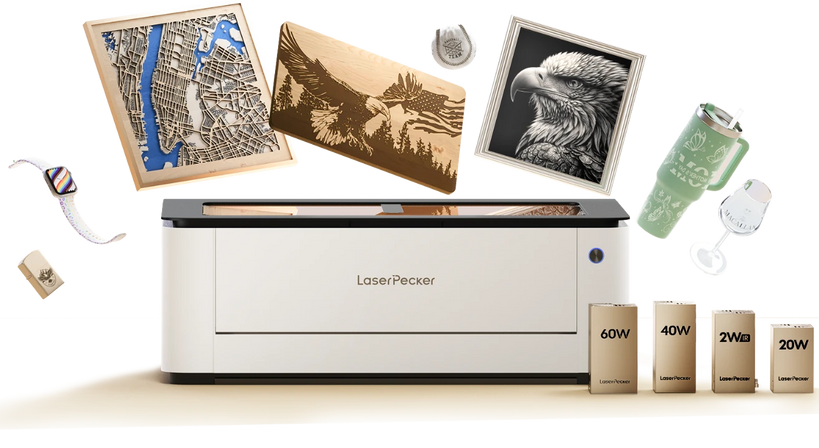
LaserPecker LP2 Plus is a more compact option for compatible small-format leather projects. Always confirm material compatibility and test the settings on a spare piece before production.

Part 3: How to Choose the Right Leather Cutting Tool for You?
Picking the right tool isn't about finding the most complex machine. It's about finding the tool that fits how you work.
For Home Leather Crafters and DIY Makers
If you're crafting small items like wallets or earrings at home, flexibility is more important than power. Laser cutters, such as the LaserPecker LX2, let you play around with shapes, test ideas fast, and get professional-looking results without needing years of experience.
For Leather Designers and Pattern Makers
Leather designers and pattern makers need tools that keep proportions exact and make it easy to iterate on designs. With laser cutting, you can quickly resize, duplicate, or tweak patterns in your digital files without redrawing them by hand, which is especially helpful when working with customers or preparing seasonal collections.
For Small Leather Businesses and Custom Leather Workshops
For small shops, being consistent matters most. Laser cutting lets you make items in batches with the same results each time. You can still add custom touches like names or logos without slowing things down. This mix of speed and personalization is hard to get with hand tools.
For High-Volume or Industrial Leather Production
Big factories that make lots of leather goods may be better off with CNC cutting systems. These are built for running all the time and focus on speed and volume instead of flexibility.
Part 4: Common Leather Cutting Mistakes to Avoid
Even the best leather cutting tools can produce poor results when the material is not prepared correctly. Avoid the following mistakes to reduce wasted leather, uneven edges, and safety risks.
Mistake 1: Skipping a Test Cut
Leather can respond differently depending on its thickness, finish, color, moisture level, and tanning process. Test the blade, speed, power, focus, and number of passes on a spare piece before cutting the final material.
Mistake 2: Using a Dull Blade or Excessive Pressure
A dull knife requires more force and is more likely to drag, slip, or create a ragged edge. Replace or sharpen the blade regularly, and use several controlled passes instead of forcing the tool through thick leather at once.
Mistake 3: Ignoring Grain, Stretch, and Natural Defects
Inspect the hide before placing the pattern. Grain direction, stretch, scars, thin spots, and surface marks can affect the strength and appearance of the finished part. Position important pieces consistently and avoid defects that could weaken the product.
Mistake 4: Failing to Secure the Leather
Leather that shifts during cutting can distort the pattern or create misaligned edges. Use suitable weights, low-tack tape, clamps, a template, or the machine’s hold-down system without damaging the surface.
Mistake 5: Using the Wrong Tool for the Pattern
A rotary cutter may be fast on long lines but difficult to control around tight corners. A manual knife may work well for a prototype but be inefficient for hundreds of repeated parts. Match the tool to the pattern complexity and production quantity.
Mistake 6: Laser-Cutting Unidentified Synthetic Leather
Some faux leather contains PVC or other unsuitable materials. Never assume a synthetic material is laser-safe. Confirm its composition with the manufacturer or supplier before placing it in a laser machine.
Mistake 7: Using Inadequate Ventilation
Laser cutting leather produces smoke, particles, and strong odors. Use an effective exhaust or filtration system, follow the machine manufacturer’s safety instructions, and never leave an operating laser unattended.
Part 5: FAQs About Leather Cutting Machines and Tools
Q1. What is the best tool for cutting leather?
The best tool depends on the leather and the project. A sharp utility or craft knife is practical for simple, low-volume work, while a rotary cutter works well for long lines on thinner leather. A laser cutter is better for intricate digital patterns and personalized products, and an industrial CNC knife cutter is more suitable for large sheets and high-volume production.
Q2. What machine is best for cutting leather?
For custom products, detailed patterns, and small-to-medium production, a laser cutting machine often provides the best balance of precision, flexibility, and repeatability. For large-scale footwear, upholstery, or automotive production, an industrial CNC knife cutter may be more appropriate. Repeated simple shapes can also be produced efficiently with a clicker press and custom die.
Q3. Can you cut leather with a laser cutter?
Yes. Compatible genuine leather and selected laser-safe synthetic leather can be cut with a laser. Results depend on the leather type, thickness, laser power, focus, speed, air assist, and number of passes. Always test a spare piece first and use effective exhaust to control smoke and odors.
Q4. What type of laser is best for cutting leather?
CO2 and blue diode lasers are commonly used for general leather cutting. CO2 machines are often selected for larger work areas or higher-volume cutting, while diode systems can be a compact option for compatible leather and smaller workshop projects. The appropriate power depends on material thickness and the required production speed, so wattage alone should not determine the purchase.
Q5. What types of leather should not be laser-cut?
Do not laser-cut PVC or vinyl-based synthetic leather, and avoid processing any leather with an unknown composition. Coatings, adhesives, dyes, and tanning chemicals vary between products, so confirm the material with the supplier and review available safety information before laser processing it.
Q6. How do you cut leather cleanly without frayed or uneven edges?
Use a sharp blade or properly tested machine settings, place the leather on a stable surface, secure it against movement, and make a test cut first. With a hand knife, use controlled passes and keep the cutting angle consistent. With a laser, optimize focus, speed, power, air assist, and exhaust to limit scorching and residue.
Q7. Is a rotary cutter or utility knife better for leather?
A rotary cutter is generally faster for long straight lines and broad curves on thinner leather. A utility or craft knife provides better control around small details, corners, and thicker material. Many leatherworkers keep both tools and choose between them based on the pattern.
Q8. How do you finish leather edges after cutting?
Edge finishing depends on the leather and cutting method. Blade-cut edges may be sanded, beveled, dyed, burnished, or coated with edge paint. Laser-cut edges may need cleaning or light sanding to remove residue or reduce darkening before burnishing or applying an edge finish. Test the finishing product on scrap leather first.
Conclusion
The best leather cutting machine or tool depends on the material, pattern, production volume, and desired edge finish. Manual knives and rotary cutters are practical for simple DIY projects and low-volume work, while CNC knife systems are designed for larger sheets and industrial production.
For makers, designers, and small businesses that need detailed cuts, repeatable patterns, and personalized engraving, a laser cutter for leather offers a flexible digital workflow. LaserPecker LX2 is suited to users who need a larger desktop cutting platform, while LaserPecker LP2 Plus provides a compact option for smaller compatible projects.
Whichever tool you choose, identify the leather composition, secure the material, keep blades sharp or machine settings tested, and follow the appropriate ventilation and safety requirements. These steps will help you produce cleaner cuts while reducing wasted material and avoidable risks.


