


Cutting fabric accurately can be challenging. Small mistakes may leave uneven edges, distort the material, or waste fabric—especially when working with denim, stretch fabrics, or multiple layers. As production grows, cutting every piece by hand also becomes slow and difficult to repeat consistently.
A fabric cutting machine can improve speed, precision, and repeatability, but different machines suit different materials and workloads. This guide compares four common types of textile cutting machines, explains their advantages and limitations, and helps you choose the best option for home projects, quilting, custom work, or production.

In this article:
- Part 1: What is a Fabric Cutting Machine
- Part 2: 4 Best Cutting Machines for Fabric
- Choice 1: Handheld Electric Rotary Cutters
- Choice 2: Manual and Electric Round Knife Cutters
- Choice 3: Industrial CNC Fabric Cutters
- Choice 4: Laser Cutting Machine for Fabric
- Part 3: How to Choose the Right Fabric Laser Cutting Machine for You?
- Part 4: FAQs about Fabric Cutting Machines
Part 1: What Is a Fabric Cutting Machine?
A fabric cutting machine is a manual, electric, or computer-controlled tool used to cut textiles into specific shapes and sizes. Compared with scissors, these machines can improve cutting speed, accuracy, and consistency while reducing physical effort.
Depending on the machine type, it may be able to:
- Cut a single layer or multiple layers of fabric
- Follow straight lines, curves, or detailed digital patterns
- Reduce distortion caused by manual cutting
- Limit fraying on compatible materials
- Repeat the same design consistently
- Support small-batch or large-scale production
Some textile cutting machines only cut material. Others, including laser cutting systems, can also engrave, mark, or add decorative details. The right choice depends on the fabric, design complexity, production volume, available space, and budget.
Part 2: 4 Types of Fabric Cutting Machines
Fabric cutting machines use different cutting methods, from handheld blades to computer-controlled laser systems. Each type offers a different balance of precision, speed, portability, layer capacity, and cost.
Choice 1: Handheld Electric Rotary Cutters
A handheld electric rotary cutter uses a motor-driven circular blade to move through fabric. It is more convenient than manual scissors for long straight cuts and simple curves, making it suitable for sewing, quilting, upholstery, and basic craft projects.
These cutters are compact, portable, and relatively easy to operate. However, the user must guide the blade by hand, so accuracy depends on skill and fabric stability. Lightweight, slippery, or stretchy materials may shift during cutting, and intricate patterns can be difficult to follow.
Choice 2: Manual and Electric Round Knife Cutters
Round knife cutters use a circular blade to cut fabric manually or with electric assistance. They are commonly used in garment workshops because they can cut several layers faster than scissors or small rotary tools.
These machines work well for straight lines and gentle curves in materials such as cotton and denim. However, the operator must still guide the cutter, and thick stacks can shift if they are not secured properly. Soft or highly elastic fabrics may also stretch or distort under blade pressure. Training and careful handling are essential, particularly when cutting detailed shapes.
Choice 3: Industrial CNC Fabric Cutters
Industrial CNC fabric cutters follow digital pattern files and use computer-controlled blades, oscillating knives, or other cutting heads. They provide high repeatability and can automatically produce complex garment or textile components.
These systems are designed mainly for factories and high-volume production. Their large cutting beds, automated workflows, and multilayer capacity make them efficient for repeated patterns. However, they usually require substantial floor space, operator training, material-handling equipment, and a higher initial investment than compact fabric cutting machines.
Choice 4: Fabric Laser Cutting Machines
A fabric laser cutting machine uses a focused beam to cut material without applying blade pressure. This non-contact process helps prevent the fabric from shifting and makes it possible to create detailed patterns, narrow curves, and repeatable shapes.
Laser cutters can process many laser-compatible fabrics, including denim, felt, linen, cotton, polyester, and selected blends. Heat can seal the edges of thermoplastic fabrics such as polyester, helping reduce fraying. Natural fibers do not melt in the same way and may show darkened edges if the settings are too strong, so every material should be tested before production.
A desktop laser cutter is useful for personalized apparel, appliqué, fabric labels, prototypes, costumes, and small-batch products. Some compact models may be described as portable or as a handheld laser cutter for fabric, but the laser should remain securely mounted during operation and be used with suitable guarding, ventilation, and fire-safety precautions.
Fabric Cutting Machine Comparison
| Machine Type | Cutting Method | Precision | Layer Capacity | Fabric Distortion | Best For |
|---|---|---|---|---|---|
| Handheld Electric Rotary Cutter | Motorized circular blade | Low–Medium | Single or a few layers | Medium–High | Home sewing and simple crafts |
| Round Knife Cutter | Guided circular blade | Medium | Several layers | Medium | Garment workshops |
| Industrial CNC Fabric Cutter | Computer-controlled blade or knife | High | Single or multiple layers | Low | Large-scale manufacturing |
| Fabric Laser Cutter | Non-contact laser beam | Very high | Usually one layer | Very low | Detailed designs and custom production |
No single machine is best for every application. Rotary and round knife cutters are practical for manual work, industrial CNC systems are suited to high-volume production, and laser cutters stand out when detailed patterns, repeatability, and minimal fabric movement are the priorities.
Part 3: How to Choose the Right Fabric Laser Cutting Machine
The best fabric laser cutter depends on the materials you use, the size and complexity of your designs, your production volume, and the space available in your workshop. Before buying, consider the following factors:
- Fabric compatibility: Confirm that the laser can safely process your cotton, denim, felt, polyester, or blended fabric. Avoid materials that may release hazardous fumes when heated.
- Working area: Choose a bed large enough for your typical patterns. Pass-through access can help with longer fabric pieces.
- Laser power: Higher power may increase cutting speed or support denser materials, but accurate control is also important for thin and heat-sensitive fabrics.
- Positioning: Camera alignment or visual positioning can make it easier to place designs on printed or pre-cut fabric.
- Software: Check whether the system accepts the file formats and design software used in your workflow.
- Ventilation and safety: Fabric cutting can produce smoke, odors, and flames. Use effective exhaust, appropriate guarding, active supervision, and suitable fire-safety equipment.
- Production volume: Home users may prefer a compact and simple machine, while businesses should prioritize repeatability, workflow efficiency, and maintenance support.
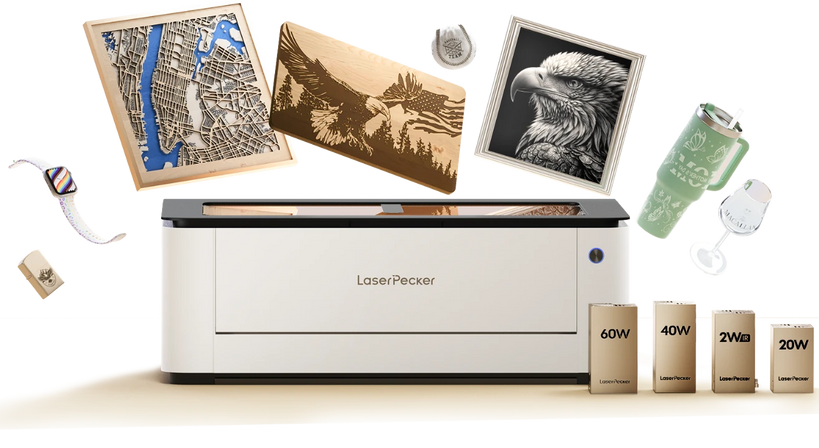
For creators and small businesses that need desktop convenience with professional cutting capabilities, the LaserPecker LX2 offers a 500 × 305 mm work area and interchangeable 20W, 40W, and 60W blue diode laser modules, plus an optional 2W infrared module for compatible marking applications.
The machine supports engraving speeds of up to 10,000 mm/s and acceleration of up to 10,000 mm/s². Actual fabric cutting speed depends on the selected laser module, material composition, thickness, and processing settings.
Its quick-swap laser system allows users to select a suitable module for different materials and projects. The 12MP camera and point-to-shape positioning system also help align designs before cutting or engraving, which is useful when working with printed fabric or detailed layouts.
With a spacious work area and side access for longer materials, the LX2 can accommodate a variety of fabric projects without requiring an industrial cutting table. It can also cut and engrave in the same workflow, making it suitable for custom apparel, patches, labels, decorative textiles, and small-batch production.
Part 4: FAQs About Fabric Cutting Machines
Q1. What Is a Fabric Cutting Machine?
A fabric cutting machine is a manual, electric, or computer-controlled device used to cut textiles into specific shapes and sizes. Common examples include rotary cutters, round knife machines, die cutters, CNC blade cutters, and fabric laser cutting machines.
Q2. What Are the Different Types of Fabric Cutting Machines?
The main types include handheld rotary cutters, round knife cutters, straight knife cutters, die-cutting machines, digital blade cutters, industrial CNC systems, and laser cutters. They differ in precision, speed, layer capacity, automation, and suitable applications.
Q3. What Is the Best Fabric Cutting Machine for Home Use?
For simple sewing and craft projects, a manual or electric rotary cutter is usually affordable and easy to store. A compact digital blade cutter is useful for repeatable shapes, while a desktop laser cutter may be the better choice for detailed patterns, custom products, and combined cutting and engraving. The best option depends on the fabric and project size.
Q4. Which Fabric Cutting Machine Is Best for Quilting?
A rotary cutter is practical for cutting straight strips, squares, and common quilting pieces. A die-cutting or digital blade machine can save time when producing repeated shapes. Laser cutting can create highly detailed appliqué and quilt components, but users should test the fabric first because heat may discolor some natural fibers.
Q5. Can a Fabric Cutting Machine Cut Multiple Layers at Once?
Yes, but layer capacity varies by machine. Round knife, straight knife, die-cutting, and industrial CNC machines can often cut multiple layers. Desktop blade and laser cutters usually work best with one layer or a small number of thin layers, depending on the material and machine specifications.
Q6. Can You Cut Fabric With a Laser Cutting Machine?
Yes. A laser can cut many compatible fabrics without applying physical pressure, making it suitable for detailed and repeatable designs. It can also seal the edges of thermoplastic fabrics such as polyester. Always test the material first, use proper ventilation, and never leave the machine unattended while cutting fabric.
Q7. What Should I Look for When Buying a Fabric Cutting Machine?
Consider fabric compatibility, working area, cutting precision, layer capacity, production speed, software, positioning features, safety protection, ventilation, maintenance, and total operating cost. The right machine should match both your current projects and expected production volume.
Conclusion
Fabric cutting machines range from simple handheld rotary cutters to automated CNC and laser systems. Rotary tools are practical for basic home sewing, round knife cutters can handle several layers in workshop settings, and industrial CNC machines are designed for large production runs.
For detailed designs, custom products, and small-batch production, a fabric laser cutting machine such as the LaserPecker LX2 offers precise, non-contact cutting and engraving in one workflow. Before choosing a machine, compare its fabric compatibility, work area, production capacity, safety features, ventilation requirements, and total cost.


